The LEHD research program’s use of longitudinally linked employer-employee data often leads to the development of prototypes for new data products. The research projects listed on this page describe planned pilot or experimental data products in the near future. A more detailed list working papers published using LEHD data be found in the Research tab.
-
Self Employment Dynamics (SED)
Lead Researcher: Kristen Sandusky
Expected Release Date: January 2027
Data Product Description: A large share of the U.S workforce earns some or all of their annual earnings from self-employment work, including contract freelance, or gig work or from independent business ownership. The Self-employment Dynamics Statistics (SED), derived from administrative records (1040 Schedule C, 1099-NEC and 1099-K) provide users with information on workforce and jobs composition and transitions in terms of how workers earn a living (wage and salary work, self-employment, or both). These statistics also capture counts and earnings associated with new, ending, and continuing self-employment jobs.
Working Paper: Business Owners and the Self-Employed: 33 Million (and Counting!)
Workforce Entry and Exit by Worker Age (2018/2019)
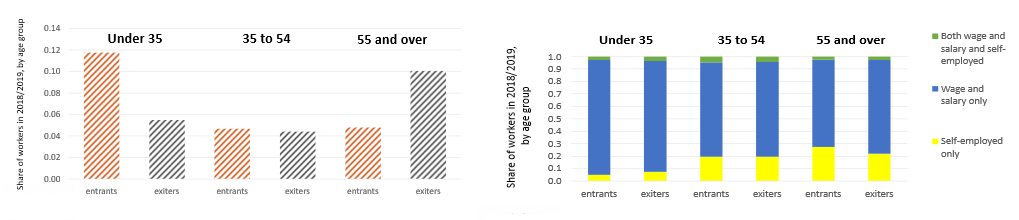
Figure Notes: The relative importance of self-employment among entering or exiting workers rises with age. Among workers under 35, one out of every eight workers is a new entrant in 2019 (versus roughly one in twenty among workers 35+). However, workers 35+ are far more likely to enter via self-employment. Similarly, among workers 55+, one worker in ten exits between 2018 and 2019, and over one quarter of these are self-employed at the time of exit.
-
Unemployment Insurance Employment Outcomes (UIEO)
Lead Researcher: Larry Warren
Expected Release Date: Late 2027
Data Product Description: We document the composition and labor market outcomes of workers who claim and receive unemployment insurance (UI). Using comprehensive administrative data on weekly UI claims in participating states, we describe the demographic, job, and employer characteristics of UI claimants. We link these claims to their earnings and job histories in the Longitudinal Employer-Household Dynamics (LEHD) data to measure their pre- and post-unemployment spell earnings, earnings changes, job characteristics, and mobility across states and industries. These new measures will further our understanding of how workers' outcomes are shaped by job displacement, mobility, social insurance, unemployment duration, and labor market recoveries.
Working Paper: Unemployment Insurance Extensions, Labor Market Concentration, and Match Quality
Working Paper: Unemployment Insurance Employment Outcomes (UIEO): The Composition and Re-employment Dynamics of UI Claimants (forthcoming)
UI Claims and Earnings Dynamics by Worker Age (2020)
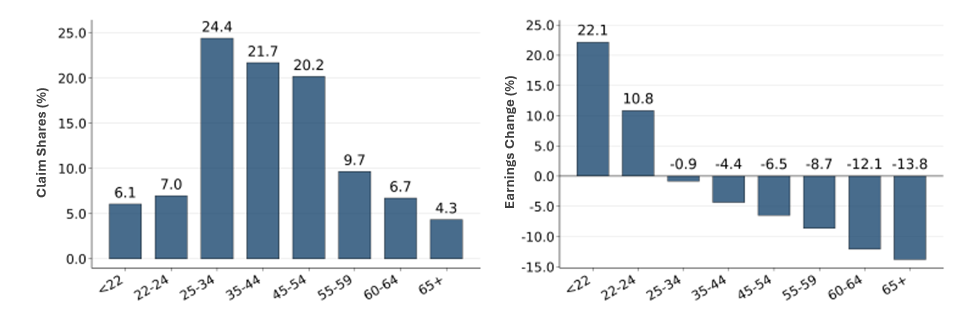
Figure Notes: The chart on the left shows the share of unemployment spells by UI recipients’ age at the start of the spell. The chart on the right shows the earnings change associated with re-employment in comparison with the job prior to the unemployment spell by these same age bins. The sample includes workers between 15 and 80 years of age who are matched to jobs before and after their unemployment spell. The sample covers 6 states (CT, MO, OH, OK, UT, and VA) with UI spells in 2020.


 255 characters maximum reached